Showing posts with label Jewish background. Show all posts

13 May 2011

Rabbinic Texts to Read and Search

Rabbinic Texts to Read and Search


It is now easy to look up most of the early rabbinic legal texts. The rabbinic texts were among the first to be digitised and there are some wonderful tools, but the good ones cost a lot of money and aren't very friendly. So I made a web-based tool for myself which is quick to use and more powerful than most.


1) Helps for Rabbinic texts online


2) Reading Rabbinic texts


3) Commercial sites and software for rabbinic texts


4) Using RabbinicTraditions.com


5) Using Ma'agarim


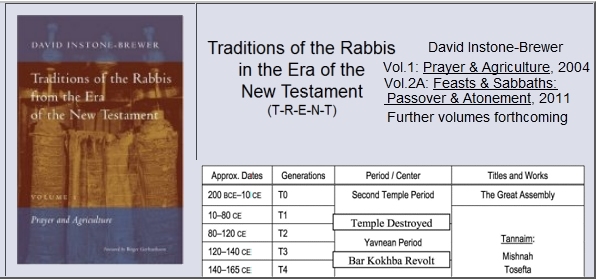
Traditions of the Rabbis in the Era of the NT

Jewish Encyclopaedia

Talmud Page

Jastrow lexicon

Rabbinic Traditions in Eng+Heb

Mamre Hebrew Rabbinic texts

Babylonian Talmud in English

Targums

Rabbinic Manuscripts

Shulchan Aruch

Davka software

Ma'agarim + Responsa

Accordance Rabbinics

Search + Browse Rabbinic Traditions

Parallel Passages in Rabbinic Traditions

Lord's Prayer in Rabbinic Traditions

Bible search in Rabbinic Traditions

Using Ma'agarim

.

1) Helps for Rabbinic texts
T-R-E-N-T.com - Traditions of the Rabbis in the Era of the NT


* The lengthy Introduction is an online sample of the paper publication
* Lists of rabbis with dates, and how to date rabbinic traditions
* summary of the structure of halakhic literature and how to read it
* limited preview of pre-70CE rabbinic traditions in other chapters

.

JewishEncyclopaedia.com


* full text, searchable
* often more useful than the newer Encyclopaedia Judaica

.


* a sample page with introductions about the various elements

Good Wiki articles

.

Jastrow - the best lexicon for rabbinic Hebrew/Aramaic


* full text at 2LetterLookup.com
* just click on first two letters then pick from the list
* lists possible Hebrew & Aramaic words & weak verbs
* full text of Jastrow and other lexicons

Abbreviations - (the bane of rabbinic texts)

* Jastrow's list of abbreviations at Wiki
* search with browser Find
* Look up the complete word at 2LetterLookup

Morfix - Dictionary for modern Hebrew <--> English

* wide range of idiomatic translations
* pointed Hebrew (unusual for modern Hebrew)

.

2) Reading Rabbinic texts
RabbinicTraditions.com


* Mishnah, Tosephta, Babylonian & Jerusalem Talmud
* Read Hebrew & English side by side
* Dating help for most named rabbis
* Search Mishnah - small subscription for other searches
* Find Scripture Refs, words, phrases in Hebrew or English
* Parallel format helps find related texts
Below are some worked examples to help you get the best out of this site.

.

Ma'agar Sifrut HaKodesh - Hebrew Rabbinic texts

* Hebrew-only, based on Mamre Institute (below)
* many texts area available, esp: 
Mishnah
Tosephta
Babylonian Talmud
Midrash Tanhuma
Maimonides' Mishnah Torah

Mechon Mamre Hebrew Rabbinic texts

* texts from traditional sources
* downloadable to PC & searchable (v old programs)

.

Soncino Babylonian Talmud in English


* PDFs of complete text of Soncino translation
* full footnotes including Hebrew characters
* downloads a tractate at a time, which is searchable

Mishnah translated at WikiSource.org

* copyright free translation
* incomplete project, but a very good start

Printed Babylonian Talmud pages at e-Daf.com

* traditional printed pages with surrounding commentaries
* Hebrew only
* Audio version!

.

Targums in English - at NTCS


* Torah Pseudo-Jonathan & Onkelos by Etheridge
* Targums for Megillot, Psalms, Isaiah

Targums in Aramaic at CAL

(Comprehensive Aramaic Lexicon)
* complete texts of Onkelos, Ps-Jonathan and others
* for easy navigation use the Tyndale Toolbar
  (Click on Bible chapter and "TgArm" version)

.

Rabbinic Manuscripts at the Jewish National and University Library


* manuscripts of Mishnah, Tosephta &  Babylonian Talmud
* usefully organised by printed folio page numbers
* more links to MSS on Davidson's page

Munich Talmud at Munich


Tosephta MSS at Bar Ilan

* all extant MSS and fragments of Tosephta

Geniza fragments at Cambridge

* MSS from 10th & 11th C Cairo Geniza collection
* valuable Targum & Talmud fragments

.

Kitzur Shulchan Aruch - English trans by Yona Newman


* Complete English, with Hebrew available as a hover (neat!)

Legends of the Jews by Ginzberg

* Complete text but no notes
  (the 3 vols of notes are the most important part!)

Come and Hear - Soncino Babylonian Talmud

* only 16 tractates, but they have full Soncino footnotes
 (use Halakhah.com instead)

Rodkinson's Talmud

* do NOT use this. I've listed it only as a warning
* this is an abbreviated version of the Talmud.

.

3) Commercial sites and software for rabbinic texts
Davka for English & Hebrew texts on PC & Mac


* Eng+Heb Babylonian Talmud (includes Mishnah)
* the above + Midrash Rabba
* Hebrew-only for allmost all other early rabbinic texts
* high prices but get on their email list and wait for a special offer.
* Search works best in English (Hebrew keyboard is difficult).

.

Ma'agarim - Academy of the Hebrew Language


* a dictionary with access to complete texts
* all Hebrew texts from Bible to Talmud
* includes Qumran Hebrew literature
* Hebrew is parsed and can be searched by grammar
* difficult to use - see work-arounds below.
* expensive - get your library to subscribe.

Responsa Project

* largest database of rabbinic works
* Hebrew-only
* expensive - get your library to subscribe. 

.

Accordance Rabbinics CD on Mac (& PC)


* English & Hebrew (most texts grammatically tagged)
* Babylonian Talmud, Mishnah, Mekhilta, Sifra, Sifre
* Targums (Onkelos, Neofiti, Pseudo-Jonathan, Geniza and other fragments)
* BibleWorks and Logos have some rabbinic texts but not nearly so good

.

4) Using RabbinicTraditions.com 
The opening screen has Search, Browse and Abbreviations


* If you know the tractate you want, click on the abbrev.
* If you want to browse the whole work, click on an Subject Order to expand it
* If you are looking for a word or Bible text, Search on the left
(some search results cost a litte - just enough to encouragedevelopment)
The bottom frame  has the important stuff:
* Introductions tell you about the texts on the site and legal restrictions
   Restrictions are very severe and necessary - sorry about that - but as painless as possible
   They apply mainly to the English text of Jerusalem Talmud and Tosephta - you can only see a few texts of each per day.
* when you select a passage, the English and Hebrew appear. You can enlarge or reduce the frames
   (Chrome won't let you - Google has an unreasonable hatred of frames)

.

Parallel Passages appear in the top frame when texts appear


Parallel Passages appear in the top frame when texts appear
  Mishnah and Tosephta follow the same tractates (with a few variations) and the Talmuds are commentaries on Mishnah, so they all follow each other. So the same material, or discussion about the same subject, are easy to find this way. Sometimes there will be parallel discussions elsewhere and you'll have to use the search facilities to find them.
The Hebrew texts are unpointed - they come from the wonderful Kodesh site.
The English texts are from Soncino (where available) and Neusner elsewhere. The Neusner translations are heavily restricted to a very strict interpretation of Fair Use, because they are in print and copyright.
The References to Talmud are rather fuller than normal, because I have included the Mishnah reference to make it easy to tie them up. 

.

An example - background for the Lord's Prayer


Let's look at the shortened version of the daily Jewish 18 Benedictions. Each rabbi taught his disciples a shortened version, like Jesus taught the Lord's Prayer.
- Start at the beginning (click on "All texts" in top middle to get back there
- This lists the Orders. The first (Zeraim) deals with Prayer, so click on it
- Ch.4 deals with the 18 Benedictions, so click on Mishnah (always the best place to start) - click on 4.3
   This summarises the different views about praying this prayer every day. Some allowed their disciples to pray a shortened version - like Jesus did.
 - The three people discussing are Gamaliel, Joshua and Akiba and their possible dates are in square brackets
   These are "generation" dates, not individual dates, so don't take them too exactly, and some like Gamaliel have more than one possible date. Also, these dates were assigned automatically, so sometimes the computer makes silly mistakes. What I'm saying is that you have to keep your wits about you, even if the computer gets it right. Dating is still something of an art rather than a science.
- click on the ">" to move to the next passage, 4.4 and you'll find a reason for praying a shorter version - because you may be attacked by bandits while your eyes are closed!
  Also, Eliezer says the wording isn't fixed, else it wouldn't be sincere. Perhaps that's why Jesus said: Pray LIKE this....  

.

Now see what Tosephta says.


- At the top you can see Mishnah 4 is actually aligned with Tosephta .3, so click on it.
- this opens the whole chapter, because alignment between Mishnah & Tosephta is not very exact. Look at 3.7 for the earliest summary prayer by Eliezer (he IS T2 - the computer says he might be T5 but this is very unlikely).
  "May your will be done in the heavens above, and grant ease to those who fear you, and do what is good in your own eyes"
  (similar to the Lord's Prayer, and also to Jesus' Gethsemane prayer "Your will be done"). 
- now look at the text in Hebrew/Aramaic on the right pane. You'll notice that 3.7 is too short. This is because of a difference in numbering. The text is from Zuckermandel, but Neusner uses the better text from Lieberman with different numbering. In this case 3.7 = 3.11 and you'll find there a variant reading, so Eliezer's prayer is:
  "May your will be done in the heavens, and grant ease to those who fear you on earth..." (be-aretz) 

.

Now let's see the parallel in Babylonian Talmud


- click on "b.Ber.26a-" and you can see that "Mishnah 4.3-6" is at "b.Ber.28b-30a" so click on that
- look at the version of Eliezer's prayer here. To find it, press Ctrl-F (the Find in your browser) and search for "Eliezer". The third occurrence on the page has his prayer:
  "May your will be done in the heavens above, and grant ease to those who fear you below...
  These variants remind us of Synoptic differences. Matthew has: "Your kingdom come. Your will be done, On earth as it is in heaven." but Luke merely has: "Your kingdom come."
  The point is that Eliezer (and Jesus) said that wording shouldn't be fixed, so individuals added expansions ad lib. Of course Jews and Christians gradually fixed the wording of prayers.

.

Now look for other parallels.


- highlight the Hebrew/Aramaic of "may your will be done" ('eshah ratzunek - words 16+17 at t.Ber.3.11) - copy then paste into the Search box on the left at "Contains word" and click on "Search in"
  (if you click on "All resources" you can narrow your search)
- there is a ref to Jerusalem Talmud which we haven't looked in yet, so click on that (y.Ber.4.2, 33a)
- scroll down the Hebrew till you find the yellow highlight.
- Scroll down the English to the same point (ie near the bottom) - look for section "[F]".
  This isn't a parallel to Eliezer's prayer. It is a later rabbi of unknown date (see Jewish Encyclopedia here) but he uses language we recognise from the Gospels:
"may it be your will, Lord my God... that you break the yoke of the evil inclination"  is very similar to "Lead us not into temptation but deliver us from evil". 

.

A quick Bible reference search


- Bible ref search - on the left "Refer to Bible" pick "Gen" and ch "1" then click "Search"
- click on the second ref (m.Yeb.6.6). This concerns the first command in Scripture: "be fruitful and multiply"
- the yellow highlight in the Hebrew/Aramaic tells you where the text is cited - at the end of the section.
- This shows the Schools of Hillel and Shammai (ie early 1st C schools) both agreed that everyone is obligated to fulfil this command till they have at least two children. 

.

5) Using Ma'agarim 
To use this, it helps to have open both Chrome and Internet Explorer.


The first one helps you translate. The second one works properly with this site.
You also need Unicode Hebrew. If you don't already have it, install the free Tyndale Unicode kit.
- it works on PC & Mac, and enables you to touch-type pointed Hebrew, accented Greek and transliterration.
To search for a word
1) Change to Hebrew keyboard (on a Mac at top right, on a PC bottom right, or Alt-Shift)
2) Type (for example) bgd for bagad "to collect" or "to cut" Aramaic
3) Open a new instance of the browser (press Ctrl-N) and do the search again, but untranslated.
The reason for having a translated and untranslated version is that the translation is often gibberish.
eg above, the root GDD has been 'translated' as "Baghdad", Qal as "easy", and Niphal as "act".
   and the two modern Hebrew synonyms for GDD have both been translated the same ("cutting" and "cutting")
To read results in context
Click on any entry. And then, to see a wider context, click on the name of the book.
When you hover over a word, you get the vocalised lemma and the root.
Click on a word and you search for that root, with one-line results.

.

Result screen


The results are presented in rough chronological order - ie based on the completion date of the various collections:
ie roughly: Dead Sea Scrolls -> Mishnah -> Halakhic Midrashim -> Tosephta -> Yerushalmi -> Bavli
Make sure you see the results in Hebrew as well as English, because the English isn't very useful at many points, eg:
In the first reference, Mishnah Makhshirin 6:6, "Mishnah" is translated "Sub" and "6:6" is translated "and and".
The text translation is very garbled too, illustrating how different modern Hebrew is from Mishnaic Hebrew, how difficult it is to translate, and how far Google Translate has yet to develop.
Black translates m.Makh.6.6 as: "These communicate uncleanness and cause susceptiveness to uncleanness: the discharge of one afflicted with a flux and his saliva and his semen and his urine ..... ". Of these, Google only translated one word correctly ("seed").
The second reference starts with an abbreviation which (annoyingly) is not listed in the "Abbreviations" (top left of the page).
- presumably they thought it was too obvious: it is for Sifre Zutta. "Desert" is the first word in the book of Numbers, so this is Sifra Numbers.
But after this, things get easier - Google correctly translates references to Tosephta, Yerushalmi (Jerusalem Talmud), and Bavli (Babylonian Talmud).
One big problem. In Chrome you can only see the first page of results. So use the Chrome version to find your way around, and while they fix this bug, use Internet Explorer to get around.

1 March 2005

Rabbinics and Jewish Research

Israel is a very web-based society. Many books, introductions and all
the basic rabbinic sources are available freely on the internet in Hebrew
though translations are more difficult to find. All the early traditions
are becoming available in my TRENT online (the translations are freely
available, but the discussions can only be previewed). This will, I hope,
enable a revival in the serious use of rabbinic material for NT research.

1) Introductions & dictionaries
2) Talmud and related ancient legal texts
3) Targums & Aggadic texts
4) Commercial software
5) Jewish-Christian interface
6) Manuscripts and archaeology
7) Later Jewish works & collections
8) Jewish jokes

1) Introductions & dictionaries

Jewish Encyclopaedia - full text and searchable, including pictures
- for ancient Judaism this is more useful than the modern Encyclopaedia Judaica
http://www.jewishencyclopedia.com/

Dictionary of the Targumim, the Talmud Babli and Yerushalmi, and the Midrashic Literature
by Marcus Jastrow - the standard English lexicon for rabbinic works.
http://www.tyndale.cam.ac.uk/jastrow/ (an experimental site - tell me if it works for you)
Hebrew alphabet & links to teach-yourself
- also has introductions to almost every other written text form. Amazing!
http://www.omniglot.com/writing/hebrew.htm

Bar mitzvah tutor - illustrated encyclopaedias of places, people, plants etc
http://bible.ort.org/intro1.asp?lang=1
incl. Torah readings with Hebrew, transliteration, translation and audio at:
http://bible.ort.org/books/torahd5.asp
and haftorah readings at: http://bible.ort.org/books/haftarotd4.asp

Jewish virtual library (actually an online encyclopaedia)
http://www.us-israel.org/jsource/index.html
Timeline: http://www.us-israel.org/jsource/History/timeline.html
Glossary: http://www.us-israel.org/jsource/gloss.html
- starts from no knowledge. A modern traditional viewpoint.

Introduction to Judaism
- from Biblical to modern times. By a Christian, but very good.
http://www.philosophy-religion.org/world/judaism.htm

Mechon Mamre - an ultra-othodox site with very useful tools & texts
http://www.mechon-mamre.org/index.htm
- plus hyperlinked introductions to Jewish lifestyle & festivals at
http://www.mechon-mamre.org/jewfaq/index.htm

Rabbis with Dates and introduction to dating rabbinic traditions
http://www.tyndale.cam.ac.uk/Brewer/PPages/trent/book/

2) Talmud and related ancient legal texts
Outline of contents for Talmuds/Mishnah/Tosephta
(all follow the same plan, mostly with same chapter numbers)
http://www.jasher.com/Btalmud.htm

Interactive Guide to Talmud page layout
- with introductions to the main commentaries etc
http://www.ucalgary.ca/~elsegal/TalmudPage.html

Babylonian Talmud in English:
The complete Talmud is only available on commercial CDs (see below)
though most of the tractates are found on one of the following sites:
Soncino translation of 16 tractates at
http://www.come-and-hear.com/talmud/index.html
Rodkinson’s translation of 22 tractates (+ 3 supplementary tractates):
http://www.sacred-texts.com/jud/talmud.htm
Rodkinson is mostly OK, but he omitted portions which are "defamatory to the Rabbis" which he thought
were inserted by Jewish-Christians (see http://www.sacred-texts.com/jud/t10/ht123.htm#fn_17)

Original-language texts
Babylonian Talmud - http://www.mechon-mamre.org/b/l/l0.htm
Jerusalem Talmud - http://www.mechon-mamre.org/b/r/r0.htm
Mishnah - http://www.mechon-mamre.org/b/h/h0.htm
Tosephta - http://www.mechon-mamre.org/b/f/f0.htm

Downloadable original-language Talmuds, Mishnah & Tosephta for PC & Palm
http://www.mechon-mamre.org/mtrpromo.htm

eDaf Talmud pages and audio explanation
- facsimiles of the traditional pages linked to audio translation & explanation
http://www.e-daf.com/ (but a simple English goy like me finds the accent difficult)

Maimonides
The 613 Commandments in Torah, compiled by Maimonides
http://www.aish.com/holidays/Shavuot/The_613_Commandments.asp
Mishnah-Torah – a restatement of the law for practical observance
http://www.mechon-mamre.org/p/p0000.htm
As yet, only the beginning is translated into English, but the first 60 chapters are completed at:
http://www.geocities.com/yona_n.geo/kizzur/kiz-index1.html
Summary of Mishnah-Torah
http://www.torah.org/learning/halacha-overview/archives.html

3) Targums & aggadic texts
Targums in Aramaic - searchable
Onqelos, Pseudo-Jonathan, Neofiti, Fragmentary, & non-Torah Targums.
http://cal1.cn.huc.edu/searching/targumsearch.html

Targums in English
Onkelos, Pseudo-Jonathan, Fragmentary trans. by Etheridge. Torah only.
http://www.tulane.edu/~ntcs/pj/psjon.htm
and for Palm at http://www.tulane.edu/~ntcs/palm/palm.html

Pirqe Rabbi Eliezer Electronic Text Editing Project
- digitisation of 3 MSS of Pirqe R Eliezer
http://www.usc.edu/dept/huc-la/pre-project/

Legends of the Jews by by Louis Ginzberg
- a readable account conflating all Jewish aggadic literature (footnotes are missing)
http://www.philologos.org/__eb-lotj/default.htm
The 3 vols of footnotes to primary references are only in the commercial version at:
http://www.bmsoftware.com/davkalegendsofthejews.htm
Mysticism during the Talmudic Era: Sources
http://www.acs.ucalgary.ca/~elsegal/Rels463/TalmudicMysticism.html

Tales And Maxims From The Midrash by Rev. Samuel Rapaport
http://www.sacred-texts.com/jud/tmm/index.htm
- large collection of selections from a wide range of Midrashim

4) Commercial software
There are lots, but these are the best:

Davka's Soncino Classics Collection
Babylonian Talmud (incl. Mishnah), Midrash Rabbah, in English & Hebrew
http://www.davka.com/cgi-bin/product.cgi?product=35
(don't buy at this price - sign up for emails and wait for special offers)

Bar Ilan Judaic Libraries
"All" rabbinic literature in Hebrew, searchable & linked
http://www.jewishsoftware.com/products/Bar_Ilan_uClassicu_Library__450.asp

Wolfson Talmud with audio translation-explanation
- linked Hebrew texts (Rashi,Tosefos,, Rambam, Shulchan Aruch) with popup dictionary
FREE CD of 1st tractate: http://www.jewishsoftware.com/default.asp?page=category&id=449


5) Jewish-Christian interface
Ancient Jewish Accounts of Jesus
Josephus, Celcus, Tertullian, Talmud, Toledoth Yeshu - full texts with introductions..
http://ccat.sas.upenn.edu/~humm/Topics/JewishJesus/

Several books on Jesus and Judaism collected by Messianic Jews
- incl. Christianity in Talmud and Midrash by R. Travers Herford
and Jesus Christ in the Talmud, Midrash, and the Zohar by Gustav Dalman
(which both deal with the censored Talmudic passages about Jesus)
http://www.saltshakers.com/lm/

TRENT - Traditions of the Rabbis in the Era of the New Testament
- earliest traditions dated and explained, esp for NT relevance
Preview at http://www.T-R-E-N-T.com

Into His Own – Primary Jewish sources for background of the NT
http://virtualreligion.net/iho/index.html

6) Manuscripts and archaeology
Inscriptions from the Land of Israel
- aims to collect all inscriptions from Israel 330 BCE - 613 CE
http://dev.stg.brown.edu/projects/Inscriptions/index.html

Talmud Manuscripts Project - (Jewish National and University Library)
- facsimiles of 78 MSS of Babylonian Talmud & Mishnah from 11 libraries
http://jnul.huji.ac.il/dl/talmud/intro_eng.htm

Geniza collection at Cambridge University
http://www.lib.cam.ac.uk/Taylor-Schechter/
- good introduction to the history and texts
- very few texts actually available
Most texts from Cambridge and elsewhere are viewable at:
http://www.princeton.edu/~geniza/
- a search engine for an improved version of these texts is at:
http://etcweb.princeton.edu/almagest2/display/search.jsp?table=document&proj=GENIZA

Marriage & Divorce Papyri of the Ancient Greek, Roman and Jewish World
- all the papyri from 4th C BCE to 4th C CE
http://www.tyndale.cam.ac.uk/Brewer/MarriagePapyri/Index.html

Ancient Kettubot - Marriage certificates
- 1200 MSS covering 900 years, searchable. Pictures of the originals are often very beautiful
http://jnul.huji.ac.il/dl/ketubbot/

Michael Davidson - Early Hebrew Printing
- links to manuscripts and editions of Rabbinic texts
http://aix1.uottawa.ca/~weinberg/hebraica.html

Ancient Synagogues
Primary sources and archaeology for ancient synagogues
http://www.pohick.org/sts/index.html

Historical Jewish Maps & Atlases
Biblical, Archeaological, Talmudic to Modern.
http://www.hum.huji.ac.il/Dinur/links/maps.htm

7) Later Jewish works & collections
RAMBI Bibliographic Index of Articles on Jewish Studies
- aims to list all scholarly articles since 1966. Good search facilities.
http://jnul.huji.ac.il/rambi/

Judaica Archival Project
- about 1000 ancient MSS which are emailed to you for a small fee
http://www.jerusalembooks.com/jap/

Jewish National and University Library Digitized Book Repository
- rare and out-of-print books, mainly in Hebrew
http://jnul.huji.ac.il/eng/digibook.html

Judaica Libraries and Archives on the Web
- links to significant collections of Judaica around the world
http://www.bibliomaven.com/

Jewish Delaware - links for ancient & modern Judaism
http://jewishdelaware.esmartweb.com/PJewishTexts.htm

Jewish History Sourcebook
- links and documents covering the whole history of the Jews
http://www.fordham.edu/halsall/jewish/jewishsbook.html

Online Texts and Documents Related to Jewish History
- covers ancient to modern, concentrating on actual texts
http://jewishhistory.huji.ac.il/links/texts.htm


8) Jewish jokes

http://www.jr.co.il/humor/index.html
http://www.awordinyoureye.com/
http://www.haruth.com/jhumorlink.htm

eg:
Why G-d Never Received Tenure at Any University:
He had only one major publication.
It was in Hebrew; had no references; wasn't published in an academic journal; and some doubt he wrote it himself.
He may have created the world, but what has he done since?
The scientific community cannot replicate his results.
He never received permission from the ethics board to use human subjects.
When one experiment went awry, he tried to cover it up by drowning the subjects.
He rarely came to class; telling the students to, "Read the book."
Some say he had his son teach the class.
He expelled his first two students.
His office hours were irregular and sometimes held on a mountain top.
Although there were only ten requirements, most students failed.

(The old ones are the best)

1 September 2002

Background to the Bible on the Web

I've re-organised the Biblical Studies page on the Tyndale site at
http://www.tyndale.cam.ac.uk/Tyndale/links_Biblical.htm
so that it is now subdivided by the following specialities:

Ancient Near Eastern Background
Egyptian Background
Graeco-Roman Background
Jewish Background
Early Church and Gnostic Background

The links are all there on the site for you to see so I won't bore
you with them all, but there are a few important highlights:


===================================================
Ancient Near Eastern Background
===================================================

Archaeology sites are becoming more important, as people realise
that publication on paper is too little, too late, and too expensive,
especially for primary site reports. Keep up to date with:

Archaeology email discussion lists at
http://www.people.ku.edu/~jyounger/archlists.html

Kevin Green's "Electronic Companion" to archaeology
http://www.ncl.ac.uk/~nktg/wintro/
A general introduction to the whole subject of archaeology.

Archaeology on the Net
http://www.serve.com/archaeology/neast.html
A large number of links to ANE and other archaeology sites

ANE texts appear on the web and then disappear. A great pity.
Most of the ones which are still there are listed at
The Internet Ancient History Source Book
http://www.fordham.edu/halsall/ancient/asbook.html


===================================================
Graeco-Roman Background
===================================================

Almost all ancient Greek texts can now be read and searched
on the web, with links to lexicons and gramatical analysis.

Use Perseus for Papyri:
List at: http://www.perseus.tufts.edu/Texts/papyri.html
Search engine at: http://www.perseus.tufts.edu/cgi-bin/txtcomplex?&display=Latin+transliteration

Use TLG for texts:
(this needs a licence - tell your library you need one)
http://stephanus.tlg.uci.edu/terranova/weblogin
Tick the box "Link to Perseus" and all the Greek words
will be linked to Perseus' lexicon and morphology engine.

Perseus now has Latin gramatical analysis as well as Greek,
and many other useful features, but as the site grows the
resources are hard to find. Use our links at: http://www.tyndale.cam.ac.uk/Tyndale/links_Biblical.htm#GraecoRomanBackground


===================================================
Jewish Background
===================================================

Background texts are important, but often difficult to find.
The following collections make like much easier.

Ancient Jewish Accounts of Jesus
http://ccat.sas.upenn.edu/~humm/Topics/JewishJesus/
Josephus, Celcus, Tertullian, Talmud, Toledoth Yeshu
- full texts with introductions.

Historical Backgrounds to the Gospels and Life of Jesus
http://www.bible.org/docs/nt/topics/backgrounds/toc.htm#TopOfPage
Extra-Biblical Citations from Jewish and some Graeco-Roman sources.

Into His Own - Perspective on the World of Jesus
http://www-rci.rutgers.edu/~religion/iho/
Citations from background texts, organised by subject.
This is a massive book-sized project by Mahlon H. Smith

My own work on Rabbinic background is at
http://www.tyndale.cam.ac.uk/Brewer/PPages/TRENT/
I'm applying modern dating techniques to rabbinic texts
to isolate and comment on traditions from the NT era.